You ski blue squares easily in Colorado or Vermont, so a red run in the Alps sounds fine. Then you're standing at the top of something steep and narrow and wondering what went wrong. Or the opposite happens: you avoid every European black because a North American black diamond scared you once, and you miss terrain you could have handled. Both mistakes come from the same assumption, that a color means the same thing on both sides of the Atlantic. It doesn't. The two systems use different colors, different reference points and different ideas about what a rating promises. Once you know how each one works, you can turn one into the other well enough to pick a sensible first run.
The North American system: shapes and colors, judged locally
In North America, as well as Australia and New Zealand, runs are rated with a combined color and shape: a green circle for easier, a blue square for more difficult, a black diamond for most difficult and a double black diamond for extremely difficult terrain. The National Ski Areas Association refined this system in 1968. The double black diamond came later. By the 1980s, better trail building and grooming, plus competition between resorts, had led to the extra top grade.
The key detail is what the symbols are measured against. The National Ski Areas Association uses the same green, blue and black symbols for its mountain bike trail signs and says they show difficulty relative to the trails at that area. Ski trails work the same way. Each resort rates its runs against its own mountain, not against other resorts. A blue square at a steep western resort and a blue square at a gentler eastern hill are each the middle grade of their own mountain. If you're comparing resorts in one region, as in our Alta vs. Snowbird comparison, keep in mind that each resort's symbols only rank the runs on its own hill. Steepness is the main thing that decides a rating, but other factors matter too, which is one reason the same symbol can feel different from place to place.
The European system: blue, red, black, plus local variations
In Europe, every country uses blue for easy, red for intermediate and black for expert runs, though the details differ from country to country. The biggest trap for North Americans is that blue sits at the bottom of the scale, not the middle. In most of the Alps there is no green at all. Blue is where beginners start.
France adds a fourth color: green for the easiest runs, below blue. That makes the French scale green, blue, red, black, so a French blue is one step harder than a blue in Austria or Switzerland. In Scandinavia and Finland, resorts use similar colors to the rest of Europe but add shapes.
Some European countries also tie their colors to measured gradients, which North America doesn't do. The German standard DIN 32912 and the Austrian ÖNORM standard set these limits:
- Blue: no more than 25 percent gradient, down the slope or across it, apart from short sections in open terrain.
- Red: no more than 40 percent gradient, with the same exception.
- Black: steeper than the red limits.
France is different. Beyond the order of the colors from green to black, no French standard sets criteria such as gradient or length for each color. A French red is a judgment call by the resort, much like a North American rating.
Grooming, ski routes and the colors past black
Grooming changes how a black feels. Green, blue and red runs are groomed in every country. Blacks are usually groomed in Italy, Austria, Switzerland and Scandinavia, but most French blacks are not. A groomed Austrian black and an ungroomed French black can be very different days out.
Many Alpine resorts also mark terrain that isn't a groomed run at all. Yellow ski routes (itinéraires in French, freeride routes in some resorts) are marked and secured against avalanches, but they are never groomed or patrolled. Skiing them is really off-piste skiing. In Austria, ski routes are usually marked with orange squares. A few areas, mostly in Austria and Switzerland, use orange for runs harder than black. North America has nothing that matches these exactly. Inside a North American resort boundary, the closest thing is ungroomed double black terrain.
How to compare the two
There's no official conversion table, so treat this as a rough guide, not a rule:
- Alpine blue (Austria, Switzerland, Italy, Germany) covers ground from a gentle North American green up to an easy blue square. A French green is the closest match to a green circle.
- European red is roughly a North American blue square, often steeper or narrower. Epic Pass, which sells access to resorts on both continents, describes reds the same way.
- European black can be anything from a single black diamond to a double black. Whether it's groomed tells you a lot.
- Yellow or orange ski routes are not a step up from black. They're a different kind of terrain: marked and secured against avalanches, but unpatrolled and ungroomed.
The same thinking works in the other direction. A European skier at Whistler Blackcomb should treat a blue square as roughly a red, not as an easy blue. A visitor at Mont Tremblant should remember that its ratings are set against its own terrain, not against the western mountains.
Common mistakes
- Reading European blue as North American blue. In most of the Alps, blue is the easiest grade.
- Assuming a French blue equals a Swiss blue. France has a green below blue, so its whole scale sits one step higher.
- Treating every black the same. Groomed Austrian blacks and ungroomed French blacks ski very differently.
- Mistaking a ski route for a run. Yellow or orange routes are not patrolled. Ski them only if you'd be comfortable off-piste.
- Comparing symbols between resorts. North American ratings only rank runs within one resort. A blue at one resort says nothing exact about a blue at another.
What to do next time
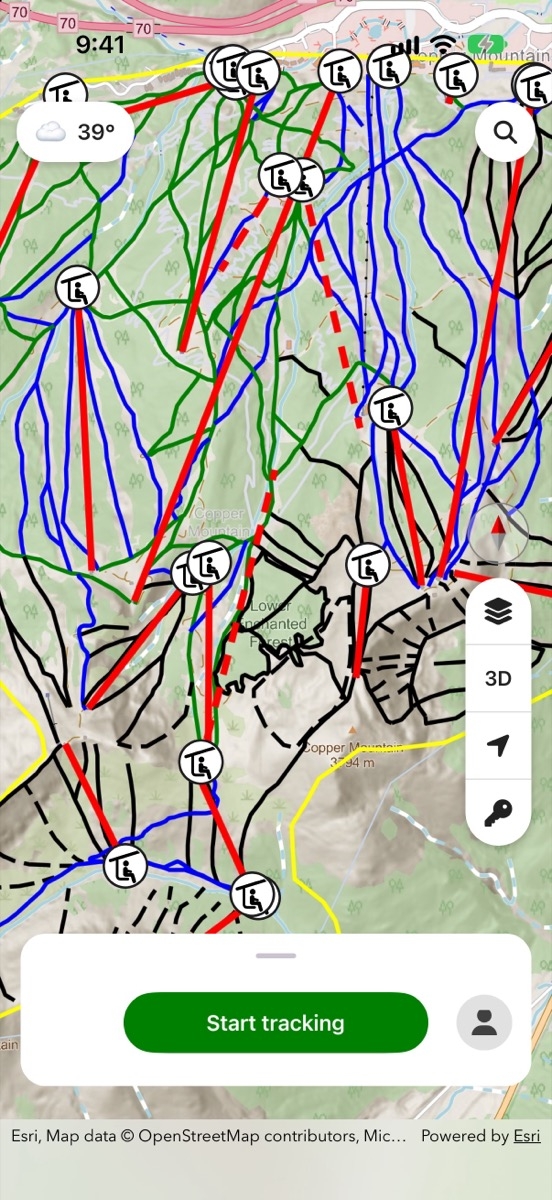
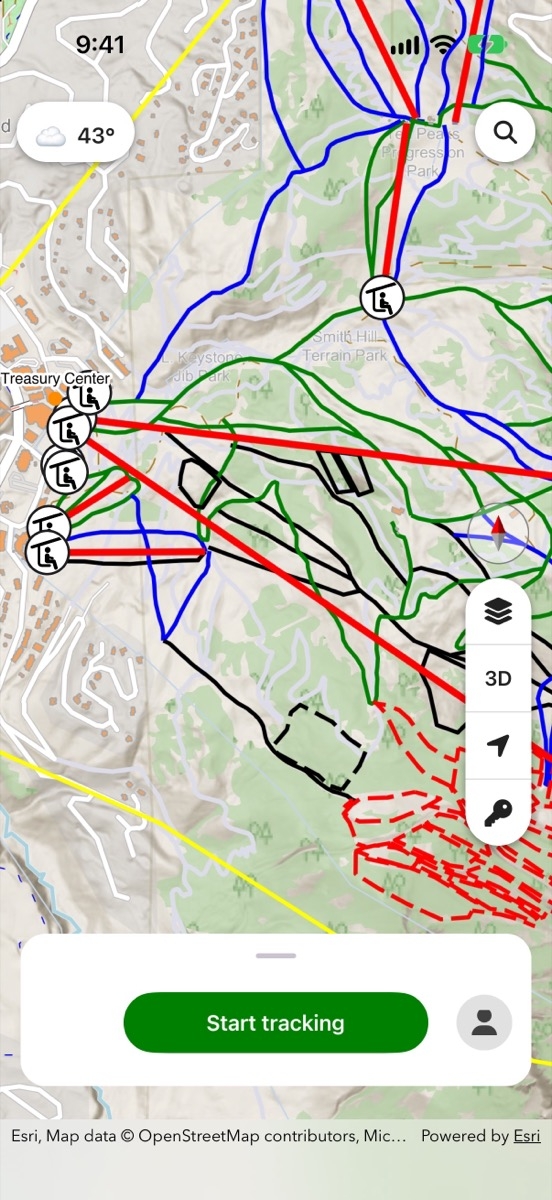
Next time you open a trail map abroad, first check which colors the legend uses and whether there's a green below blue. Then spend your first hour on runs one grade easier than you'd normally choose, so you can learn the local scale before it surprises you. Note which blacks are groomed and which lines are ski routes rather than runs. If you're planning ahead, the MountainMap app shows each resort's runs colored by difficulty, so you can see how the grades spread across a mountain before you get on the first lift.
