You open a trail map at a North American resort and most runs make sense right away: green circles, blue squares, black diamonds. Then a few runs carry two black diamonds side by side. Most people work out that this means "harder than black." That is true, but it misses what the symbol is really telling you. A double black diamond usually describes a different kind of terrain, with different consequences if something goes wrong. This guide explains where the double black sits on the rating scale, what terrain it usually marks, how it differs from a single black, and why one resort's double black may not match another's.
Where the double black sits on the scale
North American resorts use four main symbols. A green circle means easiest, a blue square means more difficult, a black diamond means most difficult, and a double black diamond is the top of the standard scale, for experts only. The National Ski Areas Association refined this trail rating system in 1968, and the Wikipedia overview of piste ratings lists the double black as "very difficult." It also notes that some areas use a triple black diamond. Resorts also use labels such as "extreme" alongside these symbols, so the legend on the map you are holding is always the final word on what each mark means.
What terrain a double black usually signals
Slope angle is the main factor in giving a trail its rating, but it is not the only one. A single black diamond already means steep ground. As a rough guide, slopes rated black diamond start at a 40 percent gradient. The second diamond usually means other dangers have been added to the steepness: vertical drops, cornices (overhanging lips of wind-packed snow), narrow chutes and cliffs. These features can force you to make a particular move, such as dropping off an edge, rather than letting you pick your own pace.
Corbet's Couloir at Jackson Hole is the textbook example. It is a double black with a 50-degree slope and a 20-foot drop over a cornice to get in. That mandatory drop is what puts most skiers off, more than the pitch below it. Our guide to why Corbet's Couloir makes Jackson Hole a must-ski covers the run in detail. Double blacks also tend to cluster. At Palisades Tahoe in California, every run on the KT-22 lift is rated either black or double black. That tells you something about the lift as well as the runs.
How it differs from a single black
The practical difference is less about how steep the run is on average and more about how much room you have for mistakes. A single black can be steep, bumpy or ungroomed, but you can usually choose where to turn, stop and rest. If you get in over your head, you can often sidestep or sideslip down slowly until you reach an easier run. On double black terrain, the drop-in, the narrow chute or the rock band may not give you that option. Before you commit to a double black, you should be confident on a resort's steepest single blacks in every kind of snow, not just on a good day.
Why one resort's double black is another's single
This is the part many skiers never learn. There is no national standard for trail ratings. The symbols look the same everywhere, but each ski area sets its own ratings, and they are relative to that area's terrain. A black diamond at a New Hampshire resort can be very different from a black diamond in Colorado. A double black at a small hill tells you it is the hardest run on that hill. It does not tell you it compares with a double black at a big western mountain. Each time you visit a new resort, start one or two levels below your usual rating and work up.
Double blacks outside North America
Fly to the Alps and the diamonds disappear. European resorts grade runs with colours: blue for easy, red for intermediate and black for difficult, and France adds green below blue. There is no double black category. Very roughly, American single blacks cover runs that might be red or black in Europe. American double blacks start at the level of true European blacks and go much steeper. In France, most black pistes are not groomed. If you are planning a trip to an Austrian resort such as St Anton, read our explainer on how ski run colours differ between Europe and North America before you choose runs by colour.
Reading double blacks on the map itself
On a printed map, the double diamond symbol sits next to the run name. On a digital map, expert terrain may be drawn in its own line style. On MountainMap, extreme double black terrain is drawn as red dashed lines, so it stands out from the ordinary black runs and the terrain parks near the base.
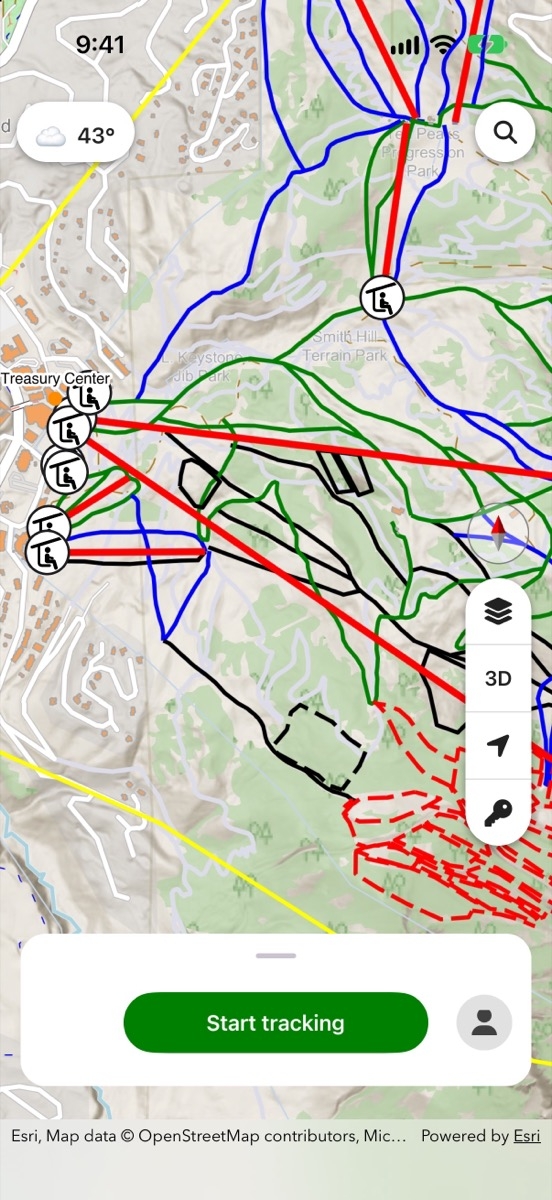
Once you have spotted the double blacks, ask two questions. First, which lift takes you to the top of them? Second, does that lift also serve an easier way down? If every run off a lift is black or double black, that lift is not for you yet, however good the view looks. Also remember that a double black inside the resort boundary is still patrolled ski area terrain. Ground beyond the boundary is something else entirely.
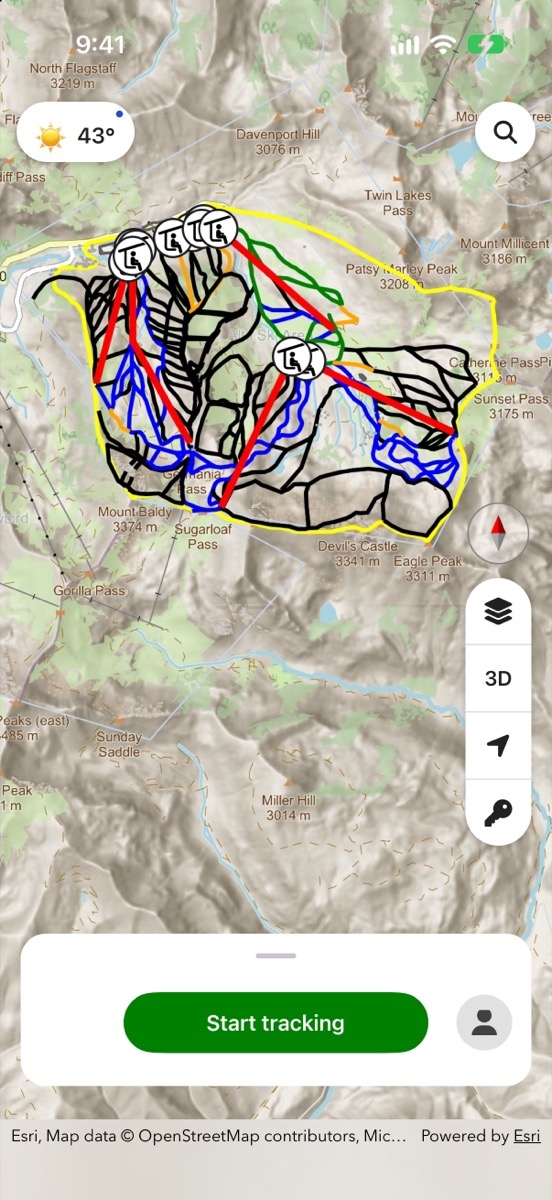
The MountainMap app shows both the expert terrain and the boundary on the same map, so you can see where the hardest runs start before you get on the lift.
Common mistakes
- Treating it as "black, plus a bit." The second diamond often means drops, cornices or chutes where a fall has serious consequences. It does not just mean a few more degrees of slope.
- Assuming ratings carry over between resorts. Ratings are relative to each area. A double black you skied at one resort does not prove you are ready for one somewhere else.
- Judging by the best conditions. The same black run can feel like a blue when it is groomed or covered in fresh powder, and much harder when the snow is icy or wind-scoured.
- Riding a lift without checking the way down. Look up every run off a lift before you load, not when you get off at the top.
- Ignoring signs and closures. The NSAA's Your Responsibility Code asks skiers to read and obey all signs, warnings and hazard markings, and to keep off closed trails and out of closed areas. A closed double black is closed for a reason.
Next time you open a trail map
Start with the legend and confirm which symbol or line style this resort uses for expert terrain. Find every double black and follow it back to the lift that serves it. Then check whether each of those lifts has a run at your level. Measure yourself against this resort's single blacks first, in today's snow. Only move up to a double black once those feel comfortable, and treat each new resort's ratings as something to test rather than trust.
